How Prokaryotes Evolve Updates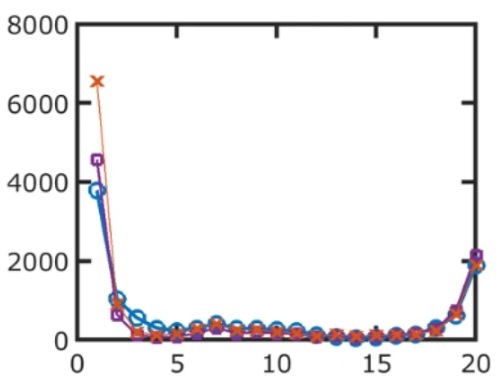 There is a basic set of genes shared by almost all prokaryotes, the "core" genome. But far more prokaryotic genes are "singletons," found in only one genome. Not too many land in between. What accounts for this U-shaped distribution?
Eugene Koonin et al., experts in biotechnology information, have studied this phenomenon. They compared the gene distribution in bacterial genomes to computer models that might generate the same distribution. After trying various assumptions about the rates of gene gain and loss, and about the size of the available gene pool, the modellers fnally succeeded. Among the E. coli genomes graphed here (blue circles) almost 4,000 genes are singletons, and 20 "core" genes are shared among almost 2,000 of the genomes. The successful model (red boxes and x's) fits almost perfectly. The first assumption in the successful model is —
New genes can be acquired only via HGT, whereas other mechanisms, such as duplication followed by divergence and de novo gene birth, are disregarded. Evidence pointing to this conclusion as been accumulating for decades, but established opinions are stubborn. Even now, mainstream biology does not recognize the reach and profundity of this new paradigm of prokaryotic evolution.
Updates Herd immunity underlies homologous recombination in stationary phase bacteria, by Pavel Payne et al, Molecular Biology and Evolution, 10 Oct 2026; and commentary, "Sex-like DNA exchange in starving bacteria...," Institute of Science and Technology Austria via Phys.Org, 01 Oct 2026.
Integrons are genetic platforms that bacteria use to capture, stockpile and rearrange small mobile elements called gene cassettes. Each cassette typically carries a single gene and its own recombination site, and the cassettes sit in arrays that can be shuffled by an integrase enzyme.... [They] also represents an evolutionary archive of functions that bacteria have recruited over millions of years.... from "New Tools Pluck Gene Cassettes From Bacteria at Unprecedented Scale," Bioengineer, 12 Sep; re: doi:10.1038/s41564-026-02474-5, Nature Microbiology, 03 Sep 2026.
Giants within: a new class of microbial mobile elements, by Yuya Kiguchi1 and Yutaka Suzuki,
TiG, Sep 2026. Herd immunity underlies homologous recombination in stationary phase bacteria, by Pavel Payne et al, Molecular Biology and Evolution, 10 Oct 2026; and commentary, "Sex-like DNA exchange in starving bacteria...," Institute of Science and Technology Austria via Phys.Org, 01 Oct 2026.
Integrons are genetic platforms that bacteria use to capture, stockpile and rearrange small mobile elements called gene cassettes. Each cassette typically carries a single gene and its own recombination site, and the cassettes sit in arrays that can be shuffled by an integrase enzyme.... [They] also represents an evolutionary archive of functions that bacteria have recruited over millions of years.... from "New Tools Pluck Gene Cassettes From Bacteria at Unprecedented Scale," Bioengineer, 12 Sep; re: doi:10.1038/s41564-026-02474-5, Nature Microbiology, 03 Sep 2026.
Giants within: a new class of microbial mobile elements, by Yuya Kiguchi1 and Yutaka Suzuki,
TiG, Sep 2026.
 24 Aug 2025: Antarctic bacteria share 'life-support' genes....
Genome Evolution in Plant Pathogenic Bacteria, by Kylie S Weis et al,
Genome Biology and Evolution, 07 Jul 2026.
Early Evolution of the Prokaryotic Transcription Factor Repertoire, by Inder Raj Singh et al,
Genome Biology and Evolution, 08 Jun 2026.
Bacterial TFs, and other genes, are routinely lost but frequently regained, presumably via horizontal acquisition from other lineages, distant or close....
Horizontal Gene Transfers Underpin Ribose Heterotrophy and Central Carbon Metabolism Remodeling in Gloeobacteraceae, by Edi Sudianto et al,
Genome Biology and Evolution, 23 May 2026.
Antibiotics stimulate protein transfer to persister cells, by Alice X. Wen et al, doi:10.1126/science.adx3972, Science, 25 Jun 2026.
...direct evidence of membrane vesicle-mediated horizontal protein transfer between bacteria.
Giants within: a new class of microbial mobile elements, by Yuya Kiguchi and Yutaka Suzuki, TiG, 29 May 2026.
Phages communicate across species to shape microbial ecosystems, by F. Gallego-del-Sol et al, PNAS, 14 May 2026.
A family of endonucleases blocks nanotube-mediated plasmid exchange, by Venkadesaperumal Gopu et al, Nature Microbiology, 03 Apr 2026.
Microbes are not just sharing genes, they are actively managing their distribution.
A bacterial CARD-NLR-like immune system controls the release of gene transfer agents, by E.J. Banks et al, Nature Microbiology; and commentary, News-Medical.Net, 16 Apr 2026.
Our findings suggest that bacterial immune systems can be co-opted to support horizontal gene transfer by GTAs.
'Kamikaze' Bacteria? by Hilton Libório.
Endonucleases Halt Nanotube-Plasmid Gene Transfer, Bioengineer.Org, 03 Apr 2026.
Dual regulatory role of IS91-encoded Orf121 in IS91 transposition, by Fauconnier, A., Da Re, S., Gaschet, M. et al, doi:10.1038/s42003-026-09874-7, Commun Biol, 25 Mar 2026.
Insertion sequences (IS) are key players in bacterial genome plasticity and horizontal gene transfer.
"Imported, not invented, genes prevail among Escherichia coli ORFans," by Sastre-Md Hassan Uz-Zaman and Howard Ochman, doi:10.1073/pnas.2523357123, PNAS, 18 Mar 2026.
Bacterial genomes contain numerous ORFans – genes lacking homologs outside the species in which they are found. ...The majority were recently acquired via horizontal transfer, with phage transduction making a significant contribution. A smaller fraction of genes emerged via sequence divergence from resident coding genes or de novo from noncoding sequences.
"Plasmids promote antimicrobial resistance through insertion sequence-mediated gene inactivation," by Sastre-Dominguez, J., Rodera-Fernandez, P., DelaFuente, J. et al, Nature [abstract], 13 Mar 2026.
"A Review of Horizontal Gene Transfer for the Natural Functional Improvement of Microorganisms Relevant to Food Technology," by Franca Rossi et al, Sci, published online by MDPI, 02 Mar 2026.
"Horizontal transfer of post-translational modifiers brings evolutionary opportunity and challenges to a conserved translation factor," by Brewer, T.E., Kielkowski, P., Stritzel, J. et al, BMC Biol, 30 Jan 2026.
"Planetary microbiome structure and generalist-driven gene flow across disparate habitats," by Chan Yeong Kim et al, Cell; and commentary, EMBL via Phys.Org and Bioengineer.org, 09 Feb 2026.
"How bacteria learned to target numerous cell types," Hebrew University of Jerusalem via Phys.Org, 02 Feb 2026. Bacteria are essentially sampling the biological world for useful binding tools and repurposing them.
"Large-scale capsid-mediated mobilisation of bacterial genomic DNA in the gut microbiome," by Borodovich, T., Buttimer, C., Wilson, J.S. et al, Nat Commun, doi:10.1038/s41467-026-68726-4 [open access abstract], 27 Jan 2026. ...an
integrated and highly active network of within- and between-species genetic exchange....
30 Dec 2025: Jumbo phages can deliver multi-gene islands.
"Phage-encoded small RNA hijacks host replication machinery to support the phage lytic cycle," by Sahar Melamed et al, Molecular Cell, 18 Dec 2025. ...how a phage-encoded sRNA can hijack host replication machinery to optimize infection.
"Genetic exchange networks bridge mobile DNA vehicles in the bacterial pathogen Listeria monocytogenes," by Muller, H., Ikhimiukor, O.O., Montoya-Giraldo, M. et al, Nat Commun, 04 Nov 2025. Our findings reveal a structured but interconnected network of genetic exchanges between different mobile DNA vehicles. 24 Aug 2025: Antarctic bacteria share 'life-support' genes....
Genome Evolution in Plant Pathogenic Bacteria, by Kylie S Weis et al,
Genome Biology and Evolution, 07 Jul 2026.
Early Evolution of the Prokaryotic Transcription Factor Repertoire, by Inder Raj Singh et al,
Genome Biology and Evolution, 08 Jun 2026.
Bacterial TFs, and other genes, are routinely lost but frequently regained, presumably via horizontal acquisition from other lineages, distant or close....
Horizontal Gene Transfers Underpin Ribose Heterotrophy and Central Carbon Metabolism Remodeling in Gloeobacteraceae, by Edi Sudianto et al,
Genome Biology and Evolution, 23 May 2026.
Antibiotics stimulate protein transfer to persister cells, by Alice X. Wen et al, doi:10.1126/science.adx3972, Science, 25 Jun 2026.
...direct evidence of membrane vesicle-mediated horizontal protein transfer between bacteria.
Giants within: a new class of microbial mobile elements, by Yuya Kiguchi and Yutaka Suzuki, TiG, 29 May 2026.
Phages communicate across species to shape microbial ecosystems, by F. Gallego-del-Sol et al, PNAS, 14 May 2026.
A family of endonucleases blocks nanotube-mediated plasmid exchange, by Venkadesaperumal Gopu et al, Nature Microbiology, 03 Apr 2026.
Microbes are not just sharing genes, they are actively managing their distribution.
A bacterial CARD-NLR-like immune system controls the release of gene transfer agents, by E.J. Banks et al, Nature Microbiology; and commentary, News-Medical.Net, 16 Apr 2026.
Our findings suggest that bacterial immune systems can be co-opted to support horizontal gene transfer by GTAs.
'Kamikaze' Bacteria? by Hilton Libório.
Endonucleases Halt Nanotube-Plasmid Gene Transfer, Bioengineer.Org, 03 Apr 2026.
Dual regulatory role of IS91-encoded Orf121 in IS91 transposition, by Fauconnier, A., Da Re, S., Gaschet, M. et al, doi:10.1038/s42003-026-09874-7, Commun Biol, 25 Mar 2026.
Insertion sequences (IS) are key players in bacterial genome plasticity and horizontal gene transfer.
"Imported, not invented, genes prevail among Escherichia coli ORFans," by Sastre-Md Hassan Uz-Zaman and Howard Ochman, doi:10.1073/pnas.2523357123, PNAS, 18 Mar 2026.
Bacterial genomes contain numerous ORFans – genes lacking homologs outside the species in which they are found. ...The majority were recently acquired via horizontal transfer, with phage transduction making a significant contribution. A smaller fraction of genes emerged via sequence divergence from resident coding genes or de novo from noncoding sequences.
"Plasmids promote antimicrobial resistance through insertion sequence-mediated gene inactivation," by Sastre-Dominguez, J., Rodera-Fernandez, P., DelaFuente, J. et al, Nature [abstract], 13 Mar 2026.
"A Review of Horizontal Gene Transfer for the Natural Functional Improvement of Microorganisms Relevant to Food Technology," by Franca Rossi et al, Sci, published online by MDPI, 02 Mar 2026.
"Horizontal transfer of post-translational modifiers brings evolutionary opportunity and challenges to a conserved translation factor," by Brewer, T.E., Kielkowski, P., Stritzel, J. et al, BMC Biol, 30 Jan 2026.
"Planetary microbiome structure and generalist-driven gene flow across disparate habitats," by Chan Yeong Kim et al, Cell; and commentary, EMBL via Phys.Org and Bioengineer.org, 09 Feb 2026.
"How bacteria learned to target numerous cell types," Hebrew University of Jerusalem via Phys.Org, 02 Feb 2026. Bacteria are essentially sampling the biological world for useful binding tools and repurposing them.
"Large-scale capsid-mediated mobilisation of bacterial genomic DNA in the gut microbiome," by Borodovich, T., Buttimer, C., Wilson, J.S. et al, Nat Commun, doi:10.1038/s41467-026-68726-4 [open access abstract], 27 Jan 2026. ...an
integrated and highly active network of within- and between-species genetic exchange....
30 Dec 2025: Jumbo phages can deliver multi-gene islands.
"Phage-encoded small RNA hijacks host replication machinery to support the phage lytic cycle," by Sahar Melamed et al, Molecular Cell, 18 Dec 2025. ...how a phage-encoded sRNA can hijack host replication machinery to optimize infection.
"Genetic exchange networks bridge mobile DNA vehicles in the bacterial pathogen Listeria monocytogenes," by Muller, H., Ikhimiukor, O.O., Montoya-Giraldo, M. et al, Nat Commun, 04 Nov 2025. Our findings reveal a structured but interconnected network of genetic exchanges between different mobile DNA vehicles.
 "Chimeric infective particles expand species boundaries in phage-inducible chromosomal island mobilization," by Lingchen He1, Jonasz B. Patkowski et al, Cell, online 09 Sep 2025. ...tailless capsids... can hijack different phage tails to form chimeric infectious particles... contributing to bacterial evolution, and commentary, by Kotaro Kiga and Rodrigo Ibarra-Chávez, Trends in Microbiology, 08 Nov 2025 (illustration, right).
"Giant extrachromosomal element 'Inocle'...," by Kiguchi, Y, Hamamoto, N, Kashima, Y et al, doi:10.1038/s41467-025-62406-5, Nat Commun, 11 Aug 2025. ...plasmid-like circular elements of 395kb....
"Cross-kingdom RNA communication in plant–bacterial interaction," by Ronald Palermo and Arne Weiberg, doi:10.1016/j.tig.2025.07.004, TiG, 30 Jul 2025; re:
"Vesicular and non-vesicular extracellular small RNAs direct gene silencing in a plant-interacting bacterium," by Antinéa Ravet, Jérôme Zervudacki et al, doi:10.1038/s41467-025-57908-1, pdf, Nature Communications, 14 Apr 2025.
Maybe not incorporated into the bacterial genome, but they're phenotypically active, transferred sRNAs.
"...microbiomes in ruminants," by Tang, Y., Zhan, P., Wu, Y. et al, doi:10.1186/s40168-025-02139-1, Microbiome, 1 Jul 2025.
Mobile genetic elements (MGEs) drive horizontal gene transfer and microbial evolution....
"Mobile integrons encode phage defense systems," by Nicolas Kieffer, Alberto Hipólito et al, Science, 08 May 2025.
"Diverse bacteria use extracellular structures called competence type IV pili (T4P)
to take up DNA from their environment," [from abstract] by Nicholas D. Christman and Ankur B. Dalia, PLoS Pathog, 21 Apr 2025.
"Distinct horizontal gene transfer potential of extracellular vesicles versus viral-like particles in marine habitats," by Biller, S.J., Ryan, M.G., Li, J. et al, Nat Commun, 03 Mar 2025.
18 Nov 2024: Transferred genes likely brought along their own regulatory elements.
"Intragenc DNA inversions expand bacterial coding capacity," by Rachael B. Chanin, Patrick T. West et al, Nature, 25 Sep 2024.
17 Oct 2025: This NEW webpage with all the links below was originally a What'sNEW posting of 10 Mar 2021.
"Hijackers, hitchhikers, or co-drivers? The mysteries of mobilizable genetic elements," by Manuel Ares-Arroyo et al, PLoS, 29 Aug 2024.
"Recurrence and propagation of past functions through mineral facilitated horizontal gene transfer," by Taru Verma et al, overview, Front. Microbiol., accepted 08 Oct 2024.
"The extent and characteristics of DNA transfer between plasmids and chromosomes," by A. Samer Kadibalban et al, doi:10.1016/j.cub.2024.06.030, Current Biology, 22 Jul 2024.
07 Jun 2024: De novo bacterial genes by reverse transcription of a "rolling circle" of RNA?
30 May 2024: GTAs ...package host DNA into virus-like capsids and transfer this DNA....
12 Jan 2024: Heterologous cell fusion is said to be another way for bacteria to exchange genes, wholesale.
06 Nov 2023: Extracellular vesicles play a much greater role in horizontal gene transfer....
30 Aug 2023: Microbial evolution is driven by ...horizontal gene transfer (HGT).
29 Apr 2023: ...clouds can transport these genes....
14 Nov 2022: Viral GTAs can supply repair templates.
05 Apr 2022: Bacteriophage and MGEs beneficial to bacteria.
25 Jan 2022: Defense cassettes are supplied by mobile genetic elements.
11 Nov 2021: ...This pattern is the same as that for prokaryotes.
"Chimeric infective particles expand species boundaries in phage-inducible chromosomal island mobilization," by Lingchen He1, Jonasz B. Patkowski et al, Cell, online 09 Sep 2025. ...tailless capsids... can hijack different phage tails to form chimeric infectious particles... contributing to bacterial evolution, and commentary, by Kotaro Kiga and Rodrigo Ibarra-Chávez, Trends in Microbiology, 08 Nov 2025 (illustration, right).
"Giant extrachromosomal element 'Inocle'...," by Kiguchi, Y, Hamamoto, N, Kashima, Y et al, doi:10.1038/s41467-025-62406-5, Nat Commun, 11 Aug 2025. ...plasmid-like circular elements of 395kb....
"Cross-kingdom RNA communication in plant–bacterial interaction," by Ronald Palermo and Arne Weiberg, doi:10.1016/j.tig.2025.07.004, TiG, 30 Jul 2025; re:
"Vesicular and non-vesicular extracellular small RNAs direct gene silencing in a plant-interacting bacterium," by Antinéa Ravet, Jérôme Zervudacki et al, doi:10.1038/s41467-025-57908-1, pdf, Nature Communications, 14 Apr 2025.
Maybe not incorporated into the bacterial genome, but they're phenotypically active, transferred sRNAs.
"...microbiomes in ruminants," by Tang, Y., Zhan, P., Wu, Y. et al, doi:10.1186/s40168-025-02139-1, Microbiome, 1 Jul 2025.
Mobile genetic elements (MGEs) drive horizontal gene transfer and microbial evolution....
"Mobile integrons encode phage defense systems," by Nicolas Kieffer, Alberto Hipólito et al, Science, 08 May 2025.
"Diverse bacteria use extracellular structures called competence type IV pili (T4P)
to take up DNA from their environment," [from abstract] by Nicholas D. Christman and Ankur B. Dalia, PLoS Pathog, 21 Apr 2025.
"Distinct horizontal gene transfer potential of extracellular vesicles versus viral-like particles in marine habitats," by Biller, S.J., Ryan, M.G., Li, J. et al, Nat Commun, 03 Mar 2025.
18 Nov 2024: Transferred genes likely brought along their own regulatory elements.
"Intragenc DNA inversions expand bacterial coding capacity," by Rachael B. Chanin, Patrick T. West et al, Nature, 25 Sep 2024.
17 Oct 2025: This NEW webpage with all the links below was originally a What'sNEW posting of 10 Mar 2021.
"Hijackers, hitchhikers, or co-drivers? The mysteries of mobilizable genetic elements," by Manuel Ares-Arroyo et al, PLoS, 29 Aug 2024.
"Recurrence and propagation of past functions through mineral facilitated horizontal gene transfer," by Taru Verma et al, overview, Front. Microbiol., accepted 08 Oct 2024.
"The extent and characteristics of DNA transfer between plasmids and chromosomes," by A. Samer Kadibalban et al, doi:10.1016/j.cub.2024.06.030, Current Biology, 22 Jul 2024.
07 Jun 2024: De novo bacterial genes by reverse transcription of a "rolling circle" of RNA?
30 May 2024: GTAs ...package host DNA into virus-like capsids and transfer this DNA....
12 Jan 2024: Heterologous cell fusion is said to be another way for bacteria to exchange genes, wholesale.
06 Nov 2023: Extracellular vesicles play a much greater role in horizontal gene transfer....
30 Aug 2023: Microbial evolution is driven by ...horizontal gene transfer (HGT).
29 Apr 2023: ...clouds can transport these genes....
14 Nov 2022: Viral GTAs can supply repair templates.
05 Apr 2022: Bacteriophage and MGEs beneficial to bacteria.
25 Jan 2022: Defense cassettes are supplied by mobile genetic elements.
11 Nov 2021: ...This pattern is the same as that for prokaryotes.
In biology all things must be proved several times — Cyril Dean Darlington, The Facts of Life, 1953. 10 Mar 2021: the What'sNEW notice that became this webpage, in Oct 2025.
15 Oct 2020: HGT can potentiate future adaptation.
18 Dec 2018: Horizontal Gene Transfer (HGT) is the only source....
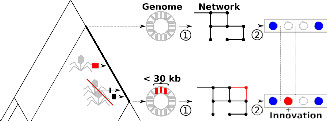 28 Oct 2018: The lateral transfer of bacterial genes by viruses....
14 Jun 2018: "...Bacteria Harpoon and Swallow DNA to Evolve" (w/ video)
28 Dec 2017: ...the predator cell can acquire antibiotic resistance.
31 Mar 2017: Cyanobacteria acquired the genes for photosynthesis relatively late....
23 Sep 2016: ...horizontal gene transfer... was the primary diversification driver.
09 Jul 2015: ...the entire basic genome is continually exchanged....
15 Jan 2015: Bacterial gene swapping... is like a messy game of telephone.
10 Sep 2014: HGT ...is the principal contributor....
more about HGT among prokaryotes, 2014-2006.
03 May 2006: Genes undergo rapid mutation and selection immediately after transfer.
28 Oct 2018: The lateral transfer of bacterial genes by viruses....
14 Jun 2018: "...Bacteria Harpoon and Swallow DNA to Evolve" (w/ video)
28 Dec 2017: ...the predator cell can acquire antibiotic resistance.
31 Mar 2017: Cyanobacteria acquired the genes for photosynthesis relatively late....
23 Sep 2016: ...horizontal gene transfer... was the primary diversification driver.
09 Jul 2015: ...the entire basic genome is continually exchanged....
15 Jan 2015: Bacterial gene swapping... is like a messy game of telephone.
10 Sep 2014: HGT ...is the principal contributor....
more about HGT among prokaryotes, 2014-2006.
03 May 2006: Genes undergo rapid mutation and selection immediately after transfer.
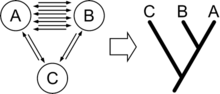 15 Mar 2006: The paradigm for evolution ...has completely shifted.
26 Sep 2005: Common bacteria share an infinite gene pool?
01 Jul 2005: A new microbial tree of life.
01 Jan 2005: Gene exchange among archaebacteria from salt pools....
17 Jan 2003: HGT is no longer an explanation of last resort....
15 Oct 2000: Entire genetic regions appear to have been transferred....
12 Jun 2000: Among bacteria, HGT is "all there is," says Ernst Mayr.
18 May 2000: HGT produces extremely dynamic bacterial genomes.
14 Apr 2000: The microbial biosphere resembles a "World Wide Web," says Joshua Lederberg.
09 Apr 2000: "In bacteria and their DNA viruses, the major process of genetic adaptation and evolution involves the horizontal transfer of genetic elements...," writes Luis P. Villarreal in 1999.
12 Aug 1998: The paradigm continues to move toward lateral gene transfer as the primary driver of evolution.
24 Apr 1998: A distinctive class of integron in the Vibrio cholerae Genome.
15 Mar 2006: The paradigm for evolution ...has completely shifted.
26 Sep 2005: Common bacteria share an infinite gene pool?
01 Jul 2005: A new microbial tree of life.
01 Jan 2005: Gene exchange among archaebacteria from salt pools....
17 Jan 2003: HGT is no longer an explanation of last resort....
15 Oct 2000: Entire genetic regions appear to have been transferred....
12 Jun 2000: Among bacteria, HGT is "all there is," says Ernst Mayr.
18 May 2000: HGT produces extremely dynamic bacterial genomes.
14 Apr 2000: The microbial biosphere resembles a "World Wide Web," says Joshua Lederberg.
09 Apr 2000: "In bacteria and their DNA viruses, the major process of genetic adaptation and evolution involves the horizontal transfer of genetic elements...," writes Luis P. Villarreal in 1999.
12 Aug 1998: The paradigm continues to move toward lateral gene transfer as the primary driver of evolution.
24 Apr 1998: A distinctive class of integron in the Vibrio cholerae Genome.
|