What'sNEW Jan - Mar 2026
More about exomoons with liquid water for, potentially, billions of years.
 "Habitability of Tidally Heated H2-Dominated Exomoons around Free-Floating Planets," by David Dahlbüdding et al, doi:10.1093/mnras/stag243, MNRAS (Open Access), 24 Feb 2026; and commentary:. "Habitability of Tidally Heated H2-Dominated Exomoons around Free-Floating Planets," by David Dahlbüdding et al, doi:10.1093/mnras/stag243, MNRAS (Open Access), 24 Feb 2026; and commentary:.
"Moons orbiting wandering exoplanets could be habitable—with one catch," by Sam Jarman, Phys.Org, 21 Mar 2026.
 09 Jan 2026: Moons around rogue planets... (related). 09 Jan 2026: Moons around rogue planets... (related).
 29 Jan 2023: Wet Panspermia, as suggested by Hoyle & Wickramasinghe, Hoover and Hand. 29 Jan 2023: Wet Panspermia, as suggested by Hoyle & Wickramasinghe, Hoover and Hand.
Life on Europa, Other Moons, Other Planets? has links about possibly habitable worlds.
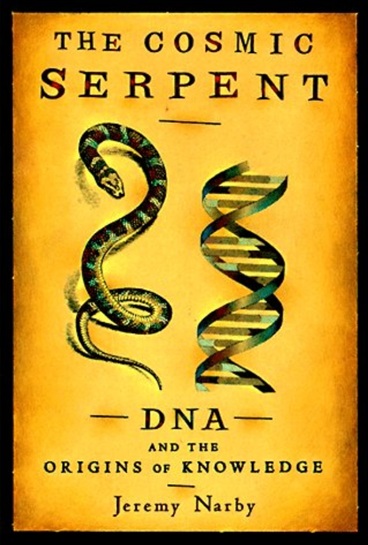 Jeremy Narby was an anthropology student who went to the Peruvian Amazon to study indigenous culture and shamanism. There, under the influence of ayahuasca, he saw vivid images like flourescent snakes. The local shaman, his trip-guide, affirmed that similar images were commonly reported. His own following study revealed that opposing snakes were often depicted in local art and religious iconography, even worldwide. Eventually he became persuaded that the visions like entwined snakes came from a very deep source. The story of his conversion is profoundly personal and engaging.
When Narby realized that DNA takes a similar shape, he became interested in genetics and the origin of life. He soon observed that even a "simple" bacterial cell is too complex to originate. He read Francis Crick's Life Itself and learned about panspermia, which he found entirely plausible. Ultimately he writes, "...last question: Where does life come from?" (p 160).
His anthropology scholarship is impressive. So is his study of evolutionary biology, where the doubts about Darwin - when Narby was writing - have since been only reinforced. His footnotes cover almost 60 pages, and the bibiolgraphy, 24.
His most controversial thesis, that the entwined snakes represent DNA, is challengng. But don't be hasty. The human genome is complex enough to produce emergent properties that can hardly be anticipated with reductionistic reasoning. Consider consciousness, or music, or motherly love. If genetic programming comes from cosmic ancestry, it could well contain meaning that we first perceive through intuition. Such intuition could explain how disparate religions have similar myths, as Narby is aware. In sum, the book is about his personal awakening to possibilities well beyond the strict science of his time. I like the message and he tells it well.
The Cosmic Serpent: DNA and the Origins of Knowledge by Jeremy Narby, ISBN-10:0874779642, Jeremy P. Tarcher/Putnam, 1998.
What Difference Does It Make? has thoughts about possible intuitive knowledge deep in the genome.
The detection of diverse nucleobases in asteroid and meteorite materials demonstrates their widespread presence throughout the Solar System....
"A complete set of canonical nucleobases in the carbonaceous asteroid (162173) Ryugu," by Koga, T., Oba, Y., Takano, Y. et al, doi:10.1038/s41550-026-02791-z, Nature, online 16 Mar 2026.
 Thanks, James Powers. Thanks, James Powers.
Comet Rendezvous has relevant Updates.
Hoyle and Wickramasinghe's Analysis of Interstellar Dust has background.
24 Mar 2026: James Powers replies with arguments in favor of postbiotic organics.
 ...human science will never be able to explain how a living being can originate from inanimate matter
— Immanuel Kant, Critique of Judgment, 1790.
...human science will never be able to explain how a living being can originate from inanimate matter
— Immanuel Kant, Critique of Judgment, 1790.
Peter Schuster, "Is there a Newton of the blade of grass?" Complexity, 23 Jun 2011.
Thanks, Avi Loeb for posting this quotation and citation.
The RNA World and Other Origin-of-Life Theories lists very many hypotheses.
...our results suggest that gene gains ...are a key driver across all the transitions from water to land....
 How does life evolve? Evolutionary biologists from Barcelona, Spain and Bristol, UK, ask specifically, how did animals become terrestrial? Analyzing whole genomes from 154 terrestrial animal species, they observe eleven adaptations from water to land in three distinct epochs, noting that "similar biological functions emerged recurrently."
Their unique approach, nicknamed InterEvo, "identifies the intersection of biological functions between different sets of genes that were independently gained or reduced in different nodes along the phylogeny...." The functions of the genes gained get careful classification (see right) in the nine-page Open Access report. This work undoubtedly advances scientific knowledge.
"Convergent genome evolution shaped the emergence of terrestrial animals," by Wei, J., Pisani, D., Donoghue, P.C.J. et al, doi:10.1038/s41586-025-09722-4, Nature, 12 Nov 2025.
How life evolves is also a thematic question for cosmic ancestry. More specifically, where do "new genes" come from? These biologists wrote, "In summary, our results suggest that gene gains (novel, novel core and expanded gene families) are a key driver across all the transitions from water to land...." And they affirm, "Novel [gene families] are those that are present in the ingroup and absent in all the outgroups…." Nowhere do they suggest that any of the new genes "originated" by an incremental process of trial-and-error. The absence of such evidence is not new. Half of educated adults have long been skeptical of the theory of evolution that depends on that process. It is time for mainstream evolutionary biologists to take notice.
The new report observes that the evolutionary transition from water to land is correlated with novel genes. This correlation comports with cosmic ancestry, in which evolution is a constructive process, assembling blocks of genetic programming, like exons or genes, which are easily acquired by transfer, via bacteria and viruses, for example.
Neo-Darwinism... lists several longstanding puzzles, including Convergent Evolution.
Introns... supports the inference that evolution is a constructive process.
...De Novo Genes has many updates about novel genes.
Curiosity ...detected the largest organic molecules yet found on Mars....
 "New Discoveries on Mars and What They Say About Habitability and Life," by Nathalie A. Cabrol, SETI Institute, 25 Feb 2026.
Life on Mars! has lots of evidence. Could the the organics be postbiotic?
"Experiment Shows Possibility of Martian Microbes Hitching a Ride to Earth" by Robin George Andrews, The New York Times, 03 Mar 2026; re:
"Extremophile survives the transient pressures associated with impact-induced ejection from Mars," by Lily Zhao et al, doi:10.1093/pnasnexus/pgag018, PNAS Nexus, 03 Mar 2026.
"Some Extremophiles Could Survive an Asteroid Impact on Mars, and the Dangerous Journey to Earth," by Evan Gough, Universe Today, 03 Mar 2026.
"Impact Survival of Microbes Highlights the Feasibility of Panspermia," by Avi Loeb, Medium, 19 Mar 2026.
Thanks, Carl Awsumb. And Google Alerts.
Bacteria: The Space Colonists has more about their space-hardiness.
 It’s really incredible to think that a few gene transfer events could have led to such a major impact in the evolution of Lepidoptera and their diversity. —
Akito Kawahara
It’s really incredible to think that a few gene transfer events could have led to such a major impact in the evolution of Lepidoptera and their diversity. —
Akito Kawahara
A gene apparently acquired from fungi helps butterflies and moths digest tough tissues and detoxify chemicals in plants. Another transfer, from bacteria, helps them digest nectar from fowers.
The quotation above and these observations come in commentary, posted on Earth.com, following a major review of the evolution of Lepidoptera. The review comes from the McGuire Center for Lepidoptera and Biodiversity, Gainesville FL.
"Moths survived 300 million years - why are they vanishing now?" by Rodielon Putol, Earth.Com,01 Mar 2026; re:
"Evolution, genomics and conservation of butterflies and moths," by Wright, C.J., Shirey, V.M., Condamine, F.L. et al, doi:10.1038/s44358-025-00128-8, (314 references) Nat. Rev. Biodivers., 16 Feb 2026.
Macroevolutionary Progress Redefined... has related discussion.
Viruses and Other Gene Transfer Mechanisms has background and many examples of HGT.
Our observational results suggest a hypothesis... that the genetic architecture underlying human cognition seems to have been established during the evolutionary stage of fish, predating the emergence of tetrapods. These words come in the Abstract of a targetted genomics investigation at the Harbin Institute of Technology, Weihai, China. Three biology and information specialists there compared whole-genome sequences from 471 species, including Neanderthals, Denisovans, modern humans, fish, amphibians, reptiles, birds, rodents, and mammals. In a table they list 18 "human cognition-related genes," along with their related "Function or compromised ability (example) when mutated." One of the genes, GNB5, is "Associated with language delay and cognitive impairment." Another one, DCC is "Associated with impaired intellectual development." The genomes of these fish and humans contain them; the genomes of many other, intervening species don't.
...it is interesting and essential to further address why these fish (coelacanths and lungfish) would retain human-like cognitive gene variants while other tetrapods (e.g., amphibians, reptiles) do not. First, according to mainstream evolutionary science, the genes must have served a purpose. The researchers suggest, "One plausible explanation is that some species of fish such as ancient lungfish faced survival challenges of greater intensity than normal amphibians and reptiles." Hmmm. As for how, or where, the fish got the genes, the specialists have nothing to say. They acknowledge a need for further study.
 "The evolution of cognitive abilities in marine animals: a hypothesis based on insights about cognition gene polymorphisms in Coelocanths and lungfish," by Zhizhou Zhang, Shuaiyu Zhang and Yongdong Xu, Academia Molecular Biology and Genomics [OA link], doi:10.20935/AcadMolBioGen8001, 28 Nov 2025.
Genes that exist before they are deployed, and genes that "seem to have come from nowhere," are basic principles of cosmic ancestry. The new study comports with these principles.
Metazoan Genes Older Than Metazoa? and
Genes Older than Earth? have many other examples of genes that appear to exist before they are deployed, and that lack any discernable darwinian provenance.
Testing Darwinism... discusses Reconstructing the Past Genomically. The method is inferential, but frequently used, because the volume of available data is huge, and growing.
Bacteria can install genes into plants. Genetic engineering can make use of them. — This bacterium facilitates horizontal gene transfer ...ensuring the altered genetic code integrates into the germ line and propagates through seeds.
"Mizzou Scientists Reveal Mechanisms Behind Plant Root Growth Regulation," Bioengineer.org, 18 Feb 2026.
Thanks, Google Alerts.
Viruses and Other Gene Transfer Mechanisms: background and ~1,000 examples of HGT benefitting eukaryotes.
"Old galaxies in a young universe?" by Martín López-Corredoira, Phys.Org, 10 Feb 2026; re:
"Improved measurements of the age of JWST galaxies at z = 6 - 10," by M López-Corredoira and C M Gutiérrez, doi:10.1093/mnras/stag089, MNRAS, 15 Jan 2026.
If this result is confirmed, it would invalidate the standard Lambda-CDM cosmological model.
01 Feb: related news.
The End and the Big Bang: background and more related news.
 Genes older than LUCA? Three American scientists, looking into the origin-of-life, see several genes that must have been complete and ready to function before LUCA, the "last universal common ancestor." These include, for example, families of aminoacyl-tRNA synthetases, the enzymes that load tRNAs with the correct amino acids. All cells must contain them. This order of events is inexplicable by neo-darwinian logic.
"Universal paralogs provide a window into evolution before the last universal common ancestor," by Aaron D. Goldman, Gregory P. Fournier and Betül Kaçar, Cell, 05 Feb 2026.
"Scientists describe a window into evolution before the tree of life," Oberlin College via EurekAlert!, 05 Feb 2026.
 the Blue Marble Space Institute of Science: an affiliation of first author Goldman. the Blue Marble Space Institute of Science: an affiliation of first author Goldman.
Thanks, Google Alerts.
Genes Older than Earth? mentions "Genes already present at the Last Universal Common Ancestor...."
The RNA World and Other Origin-of-Life Theories has related background and many updates.
How Prokaryotes Evolve: a new webpage as of 17 Oct 2025.
... dormant microorganisms inside the comet could have been reactivated by heat and the presence of temporary liquid water, metabolizing available organic compounds and releasing methane as a byproduct....
This would exemplify cometary panspermia, as proposed by Fred Hoyle and Chandra Wickramasinghe over forty years ago. The case is especially interesting because comet 3I is only the third confirmed interstellar comet to visit the inner solar system ('Oumuamua, 2017 & Borisov, 2019.)
Comet 3I reached perihelion October 29-30, 2025, at c. 1.5 au, when abundant water was released. The surprising methane, along with carbon dioxide and reduced water, was detected only six and eight weeks later, when the comet was outbound at c. 2.2 and 2.5 au.
 The Volatile Inventory of 3I/ATLAS as seen with JWST/MIRI, by Matthew Belyakov, Ian Wong et al, arXiv:2601.22034v1 [abstract | pdf], 30 Jan 2026.
Is There Life on 3I/ATLAS? by Avi Loeb (left), Medium.com, 02 Feb 2026.
Signs of methane reinforce panspermia, by Redação Bytal, MixVale.com, 04 Feb 2026.
Thanks, Google Alerts.
Comets: The Delivery System has background and updates.
"Is There Life on 3I/ATLAS?" Avi Loeb (pictured), 9-min. YouTube video, 03 Feb 2026.
Hoyle and Wickramasinghe's Analysis of Interstellar Dust began in the 1960s.
Introduction: More than Panspermia outlines the theory of cosmic ancestry.
 13 Aug 2026: more about panspermia from Loeb et al. 13 Aug 2026: more about panspermia from Loeb et al.

Mainstream theory predicted data points in the lower right corner. As we see deeper (leftward) the discrepancy grows.
|
JWST has revealed a stunning population of bright galaxies at surprisingly early epochs, z >10.... These are the opening words of a report from a large international team of astronomers seeking to observe "the earliest galaxies in the universe." The observations indicate that there are >100 times more bright early galaxies than the big bang theory predicts. This reconfirms earlier findings from the Webb telescope: Within weeks of the first science operations, JWST's images revealed an apparent abundance of bright galaxies at [z >10] challenging pre-JWST consensus models.
A Cosmic Miracle: A Remarkably Luminous Galaxy at zspec=14.44 Confirmed with JWST, by Rohan P. Naidu et al, arXiv:2505.11263v2 [abstract | pdf], 28 Jan 2026.
Webb gazes further back in time, by Bethany Downer, European Space Agency +Phys.Org, 28 Jan 2026.
We find that the early Universe looks nothing like what we predicted....
The mainstream big bang theory is severely challenged by the latest data, but it was subject to challenge already, on logical and evidentiary grounds. The news is welcome, because, if a single big bang is not the last word, the whole story, including biology, can make more sense.
12 Aug 2022: preliminary report, same story.
The End and the Big Bang has background and updates.
...the poet's job is to love people and show them... that science should resist the push toward specialization and break down the artificial boundaries between discispline that keep us from seeing the full picture of reality.
Foreward by Maria Popova to the 2025 edition of Alpha and Omega, by Jane Ellen Harrison (1915).
[1] This work demonstrates how de novo gene birth can provide immediate benefits to bacteria under viral threat.
[2] These findings highlight the capacity of unevolved sequences to give rise to biologically useful functions, underscoring a central principle in evolutionary biology: Functional novelty can arise ...directly from nongenic DNA. These sentences come in the Discussion section of a new study from MIT of phage infection in E. Coli.
Emergence of antiphage functions from random sequence libraries reveals mechanisms of gene birth, by Idan Frumkin et al, PNAS, 15 Oct 2025.

Although the first quoted sentence is demonstrably true, the second is not. The de novo genes in this study are analogous to computer access codes. When a virus attacks a bacterium, it may respond with changed codes that thwart the virus, which may also change. Repeated rounds of this can be called "immune warfare." But access codes have no functional meaning.
Where new genes come from is a thematic question of cosmic ancestry. "New genes" is my vernacular for new genetic programming —with functional meaning— that can lead to sustained macroevolutionary progress. The de novo genes in this study do not qualify. In fact, the consensus is that prokaryotes gain functional new genes exclusively by HGT.
How Prokaryotes Evolve explains the new consensus.
Macroevolutionary Progress Redefined... differentiates between
genetic changes with, and without, meaning.
Among eukaryotes, yes, de novo genes are known to supply important new functions, but immune warfare is not their source. With no apparent history of mutation-and-selection, they "seem to have come from nowhere." HGT is the likeliest explanation.
...De Novo Genes has important updates about immune warfare, including:
21 Aug 2016: Can antagonistic evolution compose de novo genes?
...the genetic architecture underlying human cognition seems to [predate] the emergence of tetrapods.
The evolution of cognitive abilities in marine animals: ...insights about cognition gene polymorphisms in Coelocanths and lungfish, by Zhizhou Zhang et al, [OA link] Academia Molecular Biology and Genomics, 28 Nov 2025.
Metazoan Genes Older than Metazoa? and Genes Older than Earth? have related examples and links.
 Moons in eccentric orbits around rogue planets may retain liquid oceans for billions of years, sustained by tidal heating alone. A pair of astronomers at the Konkoly Observatory in Budapest reach this conclusion after a deep mathematical analysis showing that a lunar orbit could remain stable even if the planet is flung free of its star. This is especially interesting, because rogue planets are far more common than we used to think.
Life in the dark:
Potential urability of the moons of rogue planets, by Viktória Fröhlich and Zsolt Regály, doi:10.1051/0004-6361/202556673, Astronomy & Astrophysics [arXiv], 06 Jan 2026.
The two astronomers suggest that life could originate on tidally-heated, rogue-orbiting moons. I notice, instead, that life could persist on them. This reminds me of "wet panspermia," the potential transfer of whole biospheres on asteroids, comets and larger bodies with long-lasting heat sources. Why not?!
29 Jan 2023: Wet Panspermia, as suggested by Hoyle & Wickramasinghe, Hoover and Hand.
Life on Europa, Other Moons, Other Planets? has links about possibly habitable worlds.
 24 Mar 2026: More about exomoons with liquid water for, potentially, billions of years. 24 Mar 2026: More about exomoons with liquid water for, potentially, billions of years.

Carl Sagan wth Viking lander (model)
|
...data from the Viking Mars mission were misinterpreted in 1976 as showing ...no life, even though the three life detection experiments ...all reported life-positive data under the terms of their experimental design. This mistake has been propagated for a half century....
...even after a half century, it is not too late to begin the back-and-forth dialectic with respect to extant life on Mars, a dialectic that begins with the Viking results. — Biochemist Steve Benner et al.
Viking Mars, Now 50 Years Old, Still Needs a Scientific Analysis, by Steven A. Benner, Dirk Schulze-Makuch, Jan Spacek and Clay Abraham, Astrobiology [pdf], online 24 Dec 2025.
Life on Mars! has background and updates
about Viking.
![]()
|
