What'sNEW
 Retroviral insertions contributed to the divergence of human and chimpanzee brains, by Patricia Gerdes et al, doi:10.1126/sciadv.aeg5791, ScienceAdvances, 23 Oct 2026.
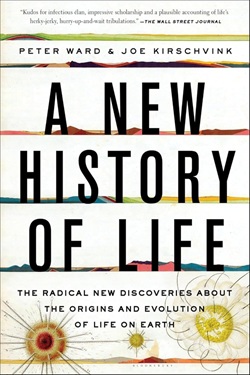 A New History of Life is actually ten years old, but its "latest research" is still news to most of us. In twenty chapters that follow Earth's geological timetable, it has especially detailed insights about transitions like the five greatest known extinction events. The authors find resources everywhere, including their own extensive field research. The text is very readable, with much more data than a general audience expects. You can definitely learn something, like, reptiles cannot breathe and run at the same time.
The book deals with almost every imaginable topic, including the definition of life, the origin of life, and eventually, the future of life. Panspermia is an acceptable possibility. My main disappointment (here and everywhere) is that the "modern synthesis" has never really happened. For example, Ward and Kirschvink are confident that basic Darwinian natural selection can bring about any innovative evolutionary next step. They are aware of gene transfer, but to account for new genetic programs – the role of neo-Darwinism – they cite one text, The Making of the Fittest, by Sean B. Carroll (2006). I have studied it. It doesn't succeed. New genes remain unexplained in mainstream evolutionary science.
The book has plenty of well-documented information to go along with some questionable assertions. (Earth is in a continuing cooling trend?) It's a monster, with no index. Still, I'm glad I took the time to read it.
A New History of Life: The Radical New Discoveries about the Origins and Evolution of Life on Earth, by Peter Ward and Joe Kirschvink, 400 pages, Bloomsbury Press, 02 Aug 2016.
"Gaia with a thousand faces," by Florian Maderspacher, Current Biology, 19 Oct 2026. Like the book, this review pays special attention to the "Snowball Earth."
 12 Nov 2006: The Making of the Fittest, reviewed.
Horizontal gene transfer (HGT) has profoundly shaped eukaryotic organellar genomes like plant mitochondria. This phenomenon gets close inspection by a pair of geneticists at the University of Florida, using a newly developed analytical tool. Their writeup concentrates on the tool and its uses; they hope it will bring helpful new information to plant taxonomy, beyond what can be learned by more traditional methods.
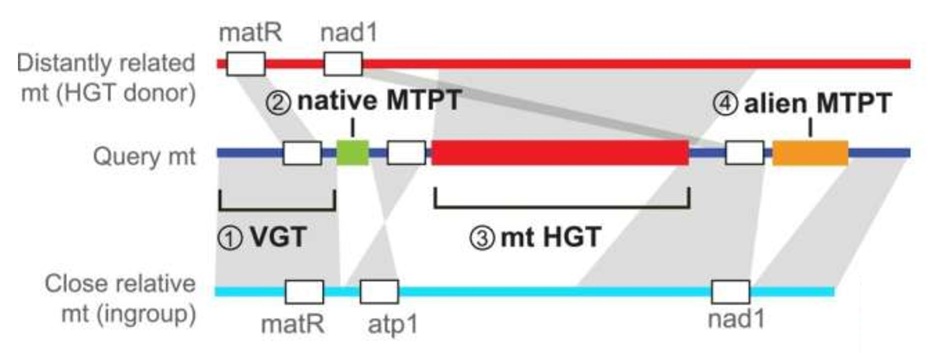 They say that blocks of genetic programming, from ~50 to ~1,500 bp originated somewhere else, when what they observe is only that the blocks appear to have been first deployed somewhere else. And the complicated insertions, deletions and rearrangements following HGT (illustrated) are carefully diagrammed without much curiosity about how this happens. My summary observation is that the long reach of HGT continues to find excess corroboration — and the implications for evolution continue to go unnoticed.
HGTScanner: Detecting horizontal gene transfer at the fine scale using whole organelle genomes, by Liming Cai and Rachel O. Cohen, Methods in Ecology and Evolution, 11 Oct 2026.
DNA analysis uncovers first known genetic connection between rare New Caledonian plant and parasitic plant, by Kyle Bumpers, University of Florida via Phys.Org, 14 Oct 2026.
 Thanks, Google Alerts.
Robust Software Management is our name for a system that rearranges transferred blocks of programming, with tools somewhat like grammar-, syntax-, spellcheck, defrag and more.
Worlds More Habitable Than Earth? They’re Out There. by Natalie Wolchover, The New York Times, 13 Oct 2026.
![]()
|