Why Sexual Reproduction? What'sNEW
When Maynard Smith reverse-engineered sex... he created a paradox. Sex should not exist; natural selection will favor asexual reproduction. The solution to the paradox is almost the Holy Grail of a large theoretical sub-branch of evolutionary biology, but it still has not been satisfactorily tracked down. — Mark Ridley, 1997 (1)
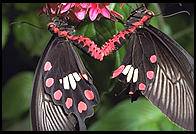 mating butterflies / © Greenspun mating butterflies / © Greenspun |
In spite of the number of ways bacteria can exchange genetic instructions, many of them haven't evolved very far — not as bacteria anyway. There are many modern bacteria that look very similar to fossils of the earliest bacteria of over 3 billion years ago. Eukaryotes are much better at evolving than prokaryotes. Eukaryotes first appeared on Earth about 1.7 billion years ago. Eukaryotic cells contain complex subunits, some of which — mitochondria and plastids — have their own DNA. With the appearance of eukaryotes, evolution began to accelerate. All multicelled animals and plants are made of eukaryotic cells. Where did they come from?
Eukaryotes by Symbiosis
Research biologist Lynn Margulis has finally won acceptance for the theory that eukaryotic cells formed by symbiosis among bacterial cells. Under the theory Margulis advocates, mitochondria and plastids did not originate within the eukaryotic cells that now carry them. Rather, these subunits were once free-living prokaryotic cells that infected other bacterial cells and came to reside in them with benefits for both parties. Even the bounded nucleus that characterizes all eukaryotic cells may have evolved this way. This is a whole new kind of evolution. Not just new genes, but new whole cells were incorporated into existing cells. This kind of evolution has already been confirmed by experiment (2). This theory represents a significant amendment to the prevailing paradigm of evolution. Now we know that evolution can proceed by assembling subunits. This mechanism would help evolution to take the giant step from prokaryotes to eukaryotes relatively quickly.
This symbiotic system has an additional consequence — as evolution proceeds, genes originally in the mitochondria and plastids apparently tend to be lost. In May, 1998, molecular biologists who analyzed 210 protein-coding genes from nine fully sequenced chloroplast genomes reported, "Some of these genes have been lost altogether,... whereas others have been transferred to the nucleus. We have documented 44 bona fide cases of functional plant nuclear genes among the 210 genes examined ..." (2.5). If mitochondria and plastids tend to lose genes, one can reason backward to a time when they had genomes as large as free-living bacteria do. This evidence strengthens the case for the symbiotic evolution Margulis advocates. And if some of those genes are transferred to the nucleus, we have another mechanism for importing whole genes into the nuclear genomes of eukaryotes.
If you had to name one development in all of evolution that was the most important single development, it would definitely be the evolution of eukaryotic cells. This step is apparently the prerequisite for any more highly organized forms of life to evolve. That the mitochondria and plastids in eukaryotes probably got there by symbiosis is a welcome insight. But we still have many other steps to explain. How did the structural system within eukaryotic cells evolve? How did eukaryotes evolve into a multitude of species with the wide variety of features they have? How do multicelled eukaryotes acquire new complex features? Where do the new genes for these steps come from? How do they get installed and activated?
Viruses and The Origin of Species
Charles Darwin named his greatest work The Origin of Species. Of course, the species is only one level of biological hierarchy. Darwin could have named his book The Origin of Phyla or The Origin of Kingdoms. A species is defined by being reproductively isolated from every other species. Darwin believed that if a sexually reproducing animal or plant were ever to take a an evolutionary step big enough to create a new species, it would be necessary for at least a complete breeding pair — one male and one female — to take the step simultaneously. If only one member of a breeding pair, say the female, acquired a speciating new feature, she would be reproductively isolated from the male. They would be unable to reproduce.
Sometimes new species can be produced by hybridization: closely related species can produce hybrid offspring that are able to sexually reproduce with other, similarly produced hybrids but not with members of either of the parents' species. Hybridization alone cannot, however, produce new features; it can only add existing ones together.
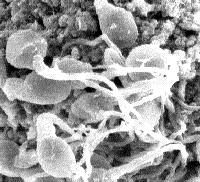 sperm cells and ovum surface: sperm cells and ovum surface:
Nanoworld Image Gallery |
The kind of speciation that interested Darwin would be that which is accompanied by the appearance of wholly new features. If new features are introduced by chance alone, sexual reproduction becomes a roadblock to speciating steps. How likely is it that two members of a breeding pair would both carry the same new, speciating feature, if it was generated by chance? Darwin didn't propose a mechanism for the generation of new features, but he saw that the evolution of a new, reproductively isolated group — that is, a new species — was a tricky problem. This is one reason he insisted on the tiny incremental steps; if a new feature were different by a only a small amount, maybe the member who carried it wouldn't be reproductively isolated from the rest of the species.
Today, with our understanding of DNA, we would state the problem differently: new features require new genetic instructions. And small steps are clearly possible without coordination between two members of a breeding pair. But big, speciating steps are still problematic for neo-Darwinism. If only one individual undergoes a mutation of speciating effect, the remaining population is either unable or unlikely to follow this "hopeful monster."
Susumu Ohno
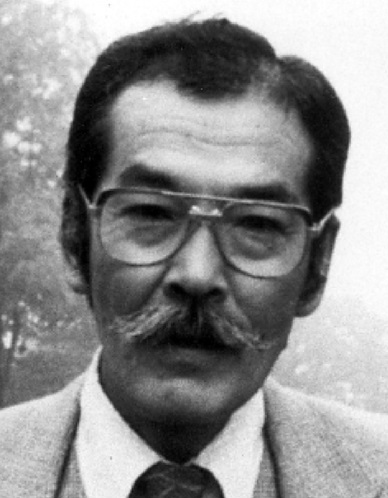 If new genetic instructions are inserted by infectious viruses, then the problem of finding breeding pairs equally equipped for big evolutionary steps is solved. Viruses typically infect whole populations, or substantial parts of them, so many breeding pairs may carry the same new instructions. This is a profound new way for evolution to advance, and in potentially larger steps than Darwin imagined. This proposed mechanism for evolution was already understood by the farseeing genetic researcher Susumo Ohno (right) in 1970. He wrote (3):
Uniform transformation from an old species to a new species can occur only if the heritable traits responsible for the speciation are carried by a viral genome. Only then can widespread infection and subsequent incorporation of the viral genome into the host genome transform a majority of the previous species members to members of a new species.
The Germ Line
If new genetic programs are as common as viral infections, wouldn't they be more likely to wreak havoc than to improve things — especially in the larger animals and plants, for whom the genome is more complicated and individuals are less expendable? For example, suppose the genetic programs for antlers or antennae got installed and activated in people. That would cause a real-life horror show. The evolutionary world would be much better if each virus infected only a narrow range of hosts. Fortunately, that is how viruses usually work. With a few exceptions, each virus infects only one species or group of closely related species. But there are important exceptions to this rule. For example, arboviruses have two classes of carriers, vertebrate and invertebrate. Sometimes one class of host may not become infected, but usually both do. Over 500 arboviruses are known (4).
Some viruses infect their hosts with no harm to the host. Other viral infections can cause diseases, occasionally lethal ones. One wishes the immune system would keep them out completely. But if evolution depends on viruses, that capability would inhibit evolution. The situation is especially complex in sexually reproducing multicelled animals, where the "germ line" is carefully protected. The germ line, the gametes and their ancestral cells that give rise to the next generation, are isolated early in the life cycle from the rest of the (somatic) cells. In order for a virus to cause evolution in sexually reproducing creatures, it must infect the germ line and become integrated into the genome there. This process has been proven to occur already. "If, for example, the DNA is injected into the nucleus of a mouse's fertilized egg, the genes will be found in many cells of the adult animal and sometimes even in its germ cells" (5). And the descendants of newborn mice infected with a virus have been shown to carry the genes of the infecting virus in their own genomes
(6). Also, "When DNA from a retrovirus is inserted into fetal lambs, their offspring inherit the retroviral DNA — a clear sign that the foreign genes had entered the sheep germline" (7). Furthermore, we now know that such insertion can happen in nature at a rate approaching one entire viral genome per host generation (8). By the time the textbook Retroviruses was published, in 1997, this question is settled. "...Retroviruses can become integrated into the germ line as endogenous viruses, leading to permanent genetic consequences for the descendents of the original host, a property they share with a variety of nonviral, but related, reverse-transcriptase-containing elements..." (9).
To accomplish this integration in nature the virus probably would have to spread by lytic infection throughout much of the body. This process will probably have side effects that may appear as symptoms of disease. Perhaps it would be a reasonable compromise if a new virus were able to establish a lytic infection and become widespread within the individual host's body one time only, and never again. Guess what. That's the way our mammalian immune system often handles viruses.
Sometimes retroviruses cause other genes in the host's genome to become "oncogenes" (10). That means they cause cancer. If evolution involves trial and error, cancer seems to be in the error category. However, perhaps it would make evolutionary sense, under some circumstances, for cells carrying newly acquired genes to begin to multiply rapidly.
AIDS
Cosmic Ancestry assumes that the function of a virus is to install its genes into the germ line of its host. After this mission has been accomplished, it serves no purpose for the host to remain susceptible to lytic infection by the virus. It would make sense if the host's descendant inheriting the new genes were born with immunity to lytic, or disease-causing, infection by the virus.
In fact, it has been known since 1933 that resistance to a disease caused by a virus can be inherited (11). Now there is some reason to believe that even resistance to AIDS may be inheritable. AIDS is an incurable viral disease to which, we once thought, no one is immune. Studies are now suggesting, however, that some children of mothers with AIDS are born immune to the disease. This is the subject of a recent [1996] story in Science, "Can Some Infants Beat HIV?" (12)
Among hundreds of children born to HIV-positive mothers, the studies found 21 who initially tested positive on HIV antibody and virus tests, but later came out negative. Referring to one of the studies, Anthony Fauci, director of the National Institute of Allergy and Infectious Diseases in Bethesda, Maryland, says: "It's pretty compelling evidence that they were able to clear the infection, or were exposed to it, got transient infection, and then cleared it."
Gene Conversion
Another vital advantage comes with sexual reproduction. It depends on a process of genetic recombination called "gene conversion." Consider the following problem: as we know, in multicelled animals most DNA is silent. Neo-Darwinists call it "junk DNA," assumed to be the leftovers of previous evolution. Natural selection cannot prevent mistakes from accumulating in silent DNA — there's no expressed feature to affect the struggle for survival. Nor can having two copies of the gene offer any protection, by itself — neither copy is expressed so there's no "working" copy to be dominant. Both copies would be equally subject to the accumulation of errors. Of course, if the silent DNA will always be silent, it won't ever matter. But if any of the silent DNA is ever to be used in the future, it needs protection against the accumulation of errors. Cosmic Ancestry holds that at least some of the silent DNA is for future use.
The Cosmic Ancestry paradigm proposes that the genetic instructions for big evolutionary steps are installed by viruses or other lateral transfer mechanisms, and that some of the steps require several genes — so many that they could hardly be installed all at once but more easily in stages. During the installation process, the not-yet-activated DNA would be silent. To be useful in the future, this silent DNA would need protection against the accumulation of errors.
Among the working genes of sexually reproducing creatures, gene conversion can alter one version of a gene to match the other version. Thus, a defective gene can be edited to match the nondefective version of the gene (12.5):
Occasionally... one of the two copies of the paternal allele [version] has been changed to a copy of the maternal allele. This phenomenon is known as gene conversion. It often occurs in association with genetic recombination events, and it is thought to be important in the evolution of certain genes.... Gene conversion is thought to be a straightforward consequence of the mechanisms of general recombination and DNA repair.
So if an error develops in one copy of the gene, the process of gene conversion could compare it to the undamaged copy and fix it. In the above example, gene conversion has been demonstrated for working genes. Is there any reason to think that gene conversion also works on silent DNA? Yes. There is indirect evidence based on an otherwise unexplained similarity between silent DNA in humans and mice (13):
Koop and Hood have found that the DNA of the T cell receptor complex... shows 71% identity between humans and mice. That finding is startling, since only 6% of the DNA encodes for the actual protein sequence, while the rest consists of introns and noncoding regions.
The last common ancestor of humans and mice died at least 80 million years ago. Somehow the silent DNA has been maintained over many millions of replications. Gene conversion could be the mechanism. Something is.
If gene conversion works for silent DNA, it becomes possible for very large genetic programs to be installed in stages, without loss of fidelity. The parts installed first would be silent until the whole program had been installed. With gene conversion, this silent part could get continually debugged. The process of gene conversion could clean it up, as necessary, every time it is replicated. Thus, when the whole new genetic program is fully installed and ready to activate, it would be far more likely to be fully functional. The process of gene conversion could make it possible to install big genetic programs in pieces, over many generations.
Additional evidence for the longterm maintenance of silent genes comes from research on certain "retrotransposons" by biologists at The University of Rochester. They studied two related sequences that have remained stable in diverse lineages for over 500 million years. The sequences are always inserted at the same two precise locations in a certain (28S rRNA) gene, inactivating it. "How then do we account for their remarkable stability?" they wonder (14).
Summary
So it is necessary, at least intermittently..., this thing called sex. As of course you and I knew it must be. Otherwise surely, by now, we mammals and dragonflies would have come up with something more dignified. — David Quammen (15)
 Evolution can proceed by the assembly of subunits. Evolution can proceed by the assembly of subunits.
New genes can get installed into whole species by infectious agents, especially viruses.
Viral infections are usually specific to certain hosts only, they are not always harmful to the host, they can enter the germline, and the host can become immune to their harmful effects.
The process of gene conversion can correct deleterious mutations even in silent genes, where natural selection and gene dominance are useless. Gene conversion could protect large genetic programs requiring several generations to install. Thus sex would be important because it increases the fidelity, not the mutability, of inherited genes. Indeed, a clever recent experiment with sexual and asexual yeast cells that were otherwise identical reinforces this last point. Clifford Zeyl of Michigan State University and Graham Bell of McGill University found that both the sexual and asexual populations produced mutations at similar rates, but the sexual cells eliminated deleterious mutations more efficiently (16). And yet another experiment, with viruses, affirms that sex prevents the accumulation of deleterious mutations "because recombination lets an organism reconstruct a mutation free genome from two genomes that contain different mutations" (17).
It seems likely that the sexual reproduction process used by multicelled animals and plants is more important than the current paradigm imagines. It is a likely prerequisite for really big evolutionary steps.
What'sNEW
 15 May 2023: Concerted Evolution uses gene conversion to explore human duplicated genes. 15 May 2023: Concerted Evolution uses gene conversion to explore human duplicated genes.
 Repeat sequences limit the effectiveness of lateral gene transfer and favored the evolution of meiotic sex in early eukaryotes, by Marco Colnaghi et al., doi:10.1073/pnas.2205041119, PNAS, 22 Aug 2022. The origin of meiotic sex is a long-standing evolutionary enigma. ...We link its origin to the expanded genome size and proliferation of genetic repeats found in early eukaryotes. Repeat sequences limit the effectiveness of lateral gene transfer and favored the evolution of meiotic sex in early eukaryotes, by Marco Colnaghi et al., doi:10.1073/pnas.2205041119, PNAS, 22 Aug 2022. The origin of meiotic sex is a long-standing evolutionary enigma. ...We link its origin to the expanded genome size and proliferation of genetic repeats found in early eukaryotes.
Y recombination arrest and degeneration in the absence of sexual dimorphism, by Thomas Lenormand and Denis Roze, doi:10.1126/science.abj1813, Science, 11 Feb 2022. In contrast to current theory, the whole process occurs without any selective pressure related to sexual dimorphism.
A new model of sex chromosome evolution, by Pavitra Muralidhar and Carl Veller, Science, 11 Feb 2022.
The puzzling guppy Y chromosome by Deborah Charlesworth, Nature Reviews Genetics, 04 May 2021.
Picozoans Are Algae After All... by Christie Wilcox, The Scientist, 06 May 2021.
If there were two endosymbiotic events, but those endosymbionts came from very closely related cyanobacteria, would we even ...be able to tell?
Mitotic gene conversion can be as important as meiotic conversion... by Xianqing Jia, Qijun Zhang, Mengmeng Jiang et al., doi:10.1371/journal.pbio.3001164, PLoS Biol., 22 Mar 2021.
Isolation of an archaeon at the prokaryote-eukaryote interface by Hiroyuki Imachi et al., doi:10.1038/s41586-019-1916-6, Nature, 15 Jan 2020.
A little bit of sex prevents mutation accumulation even in apomictic polyploid plants by Ladislav Hodac et al., BMC Evol. Biol., 14 Aug 2019.
Transmissible cancer and the evolution of sex by Frédéric Thomas, Thomas Madsen et al., PLoS Biol., 06 Jun 2019. Here, we propose ...that sexual reproduction not only evolved to reduce the negative effects of the accumulation of deleterious mutations ...but also to prevent invasion by transmissible selfish neoplastic cheater cells....
Anisogamy evolved with a reduced sex-determining region in volvocine green algae by Takashi Hamaji, Hiroko Kawai-Toyooka et al., Communications Biology, 08 Mar 2018. In essence, the major difference between males and females in Eudorina could be reduced to the presence or absence of a single gene.... and commentary from
Danforth Center +Newswise.
Through Sex, Nature Is Telling Us Something Important by Alexey S. Kondrashov, doi:10.1016/j.tig.2018.01.003, Trends in Genetics, May 2018.
Sex: Not all that it's cracked up to be? by Sebastian Eves-van den Akker and John T. Jones, PLoS Genet., 22 Feb 2018.
Gene Conversion Facilitates Adaptive Evolution on Rugged Fitness Landscapes by Philip Bittihn and Lev S. Tsimring, G3, 01 Dec 2017. Our results reveal the potential for duplicate genes to act as a "scratch paper" that frees evolution from being limited to strictly beneficial mutations in strongly selective environments.
Frequent nonallelic gene conversion on the human lineage and its effect on the divergence of gene duplicates by Arbel Harpak, Xun Lan et al., doi:10.1073/pnas.1708151114, PNAS, 28 Nov 2017. We find that the baseline rate of [nonallelic gene conversion] in humans is 20 times faster than the point mutation rate.
Mating in the Closest Living Relatives of Animals Is Induced by a Bacterial Chondroitinase by Arielle Woznica, Joseph P. Gerdt et al., doi:10.1016/j.cell.2017.08.005, Cell, online 03 Sep 2017. ...bacteria likely regulate choanoflagellate mating in nature.
Could stress-specific mutations lead to different evolutionary paths? by Deepa Agashe, doi:10.1371/journal.pbio.2002862, PLoS Biology, online 08 Jun 2017. ...without sex, mutation-free regions of two genomes cannot recombine and generate mutation-free offspring.
 Evolving 'lovesick' organisms found survival in sex University of Adelaide (+Newswise), 28 Mar 2017. Evolving 'lovesick' organisms found survival in sex University of Adelaide (+Newswise), 28 Mar 2017.
Higher rates of sex evolve during adaptation to more complex environments by Pepijn Luijckx et al., doi: 10.1073/pnas.1604072114, PNAS, online 04 Jan 2017.
A Surveillance Mechanism Ensures Repair of DNA Lesions during Zygotic Reprogramming by Sabrina Ladstätter and Kikuë Tachibana-Konwalski, doi:10.1016/j.cell.2016.11.009, Cell, online 01 Dec 2016.
Inevitability and containment of replication errors for eukaryotic genome lengths spanning megabase to gigabase by Mohammed Al Mamun, Luca Albergante et al., doi:10.1073/pnas.1603241113, PNAS, online 14 Sep 2016.
Remarkably Long-Tract Gene Conversion Induced by Fragile Site Instability in Saccharomyces cerevisiae by Shahana A. Chumki et al., doi:10.1534/genetics.116.191205, Genetics, 01 Sep 2016.
Apparent Epigenetic Meiotic Double-Strand-Break Disparity in Saccharomyces cerevisiae: A Meta-Analysis by Franklin W. Stahl et al., doi:10.1534/genetics.116.191635, Genetics, 01 Sep 2016.
Repeated replacement of an intrabacterial symbiont in the tripartite nested mealybug symbiosis by Filip Husnik and John P. McCutcheon, doi:10.1073/pnas.1603910113, PNAS, online 29 Aug 2016. These results show that highly integrated and interdependent symbiotic systems can experience symbiont replacement and suggest that similar dynamics could have occurred in building the mosaic metabolic pathways seen in mitochondria and plastids.
14 Jun 2016: ...Robust software management systems must effect the assembly, deployment, repair and optimization of acquired genetic programs. (Mentions Gene Conversion.)
How the First Plant Came to Be by David Biello, Scientific American, 16 Feb 2016.
Sex speeds adaptation by altering the dynamics of molecular evolution by M. J. McDonald et al., doi:10.1038/nature17143, Nature, 10 Mar 2016.
Using Sex to Cure the Genome by Eduardo P. C. Rocha, doi:10.1371/journal.pbio.1002417, PLoS Biol., 17 Mar 2016.
Whole-Genome Analysis of Individual Meiotic Events in Drosophila melanogaster Reveals that Noncrossover Gene Conversions are Insensitive to Interference and the Centromere Effect by Danny E. Miller et al., doi:10.1534/genetics.115.186486, Genetics, online 4 Mar 2016.
UI biologists find sexuality, not extra chromosomes, benefits animal, The University of Iowa (+Newswise), 21 Jan 2016.
Horizontal transfer of short and degraded DNA has evolutionary implications for microbes and eukaryotic sexual reproduction by Søren Overballe-Petersen and Eske Willerslev, doi:10.1002/bies.201400035, Bioessays, Oct 2014. Rather, sexual reproduction represents a type of controlled selective HGT that optimizes the evolutionary advantage of homologous genetic exchange by maintaining relatively high barriers to random interfering transfers. Furthermore, in our opinion sexual reproduction was a prerequisite for the evolution of multicellularity due to this shielding from "genetic interference" from random HGT that allowed for a stable cooperation of cell consortia, eventually resulting in true multicellularity.
Leveraging Distant Relatedness to Quantify Human Mutation and Gene-Conversion Rates by Pier Francesco Palamara et al., doi:10.1016/j.ajhg.2015.10.006, AJHG, online 12 Nov 2015.
Long-Lasting Gene Conversion Shapes the Convergent Evolution of the Critical Methanogenesis Genes by Sishuo Wang et al., doi:10.1534/g3.115.020180, GGG, 1 Nov 2015.
Aneil F. Agrawal, "Evolutionary biology: Infection elevates diversity," doi:10.1038/525464a, Nature, 24 Sep 2015.
Ningxin Zhang et al., "Selective Advantages of a Parasexual Cycle for the Yeast Candida albicans" [abstract], doi:10.1534/genetics.115.177170, Genetics, 1 Aug 2015.
Sex life of ancient Fractofusus organism revealed by Rebecca Morelle, BBC News, 3 Aug 2015.
Dave Speijer et al., "Sex is a ubiquitous, ancient, and inherent attribute of eukaryotic life" [abstract], doi:10.1073/pnas.1501725112, PNAS, 21 Jul 2015.
Richard G. Dorrell and Christopher J. Howe, "Integration of plastids with their hosts: Lessons learned from dinoflagellates" [abstract], doi:10.1073/pnas.1421380112, PNAS, online 20 May 2015.
...An Interview with Ford Doolittle by Jane Gitschier [mentions Lynn Margulis], PLoS Genet, 7 May 2015.
Sebastian G. Gornik et al., "Endosymbiosis undone by stepwise elimination of the plastid in a parasitic dinoflagellate" [abstract], doi:10.1073/pnas.1423400112, PNAS, online 20 Apr 2015.
Duality in the human genome, MedicalXpress, 28 Nov 2014.
Physicists' model proposes evolutionary role for cancer by Zeeya Merali, Nature News, 2 Oct 2014.
Eunice Yim, Karen E. O'Connell, Jordan St. Charles and Thomas D. Petes, "High-Resolution Mapping of Two Types of Spontaneous Mitotic Gene Conversion Events in Saccharomyces cerevisiae" [Oen Access abstract], doi:10.1534/genetics.114.167395, p 181-192 v 198, Genetics, 1 Sep 2014.
Sa Geng, Peter De Hoff and James G. Umen, "Evolution of Sexes from an Ancestral Mating-Type Specification Pathway" [html], doi:10.1371/journal.pbio.1001904, PLoS Biology, online 8 Jul 2014.
Doris Bachtrog et al., "Sex Determination: Why So Many Ways of Doing It?" [html], doi:10.1371/journal.pbio.1001899, PLoS Biology, online 1 Jul 2014.
"Making new species without sex" [html], Max-Planck-Gesellschaft, 10 Jun 2014.
Diego A. Hartasánchez et al., "Interplay of Interlocus Gene Conversion and Crossover in Segmental Duplications under a Neutral Scenario" [abstract], doi:10.1534/g3.114.012435, Genes|Genomes|Genetics, online 6 Jun 2014.
Death by asexuality: IU biologists uncover new path for mutations to arise, Indiana University (+Newswise), 3 Sep 2013.
David Green and Chris Mason, "The maintenance of sex: Ronald Fisher meets the Red Queen" [abstract], doi:10.1186/1471-2148-13-174, n174 v13, BMC Evolutionary Biology, 21 Aug 2013.
Christopher S Willett, "Gene conversion yields novel gene combinations in paralogs of GOT1 in the copepod Tigriopus californicus" [abstract], doi:10.1186/1471-2148-13-148, n148 v13, BMC Evolutionary Biology, 12 Jul 2013. "The evolutionary patterns across these paralogs show how gene conversion can both constrain and facilitate diversification of genetic sequences."
David B Carlini et al., "Parallel reduction in expression, but no loss of functional constraint, in two opsin paralogs within cave populations of Gammarus minus (Crustacea: Amphipoda)" [abstract], doi:10.1186/1471-2148-13-89, n89 v13, BMC Evolutionary Biology, 23 Apr 2013. "...dN/dS ratios did not indicate a relaxation of functional constraint in the cave populations with reduced or absent eyes. Maximum likelihood analyses using codon-based models also did not detect a relaxation of functional constraint in the cave lineages."
Slideshow: Virgin Birth Not So Miraculous in Animal Kingdom by Carrie Arnold, ScienceNow, 27 Dec 2012.
Bruce A. Curtis et al., "Algal genomes reveal evolutionary mosaicism and the fate of nucleomorphs" [html], doi:10.1038/nature11681, p59-65 v492, Nature, 6 Dec 2012; and commentary:
Microscopic Indigestion Caught in the Act, Dalhousie University (+Newswise), 6 Dec 2012.
Sihai Yang, Yang Yuan, Long Wang et al., "Great majority of recombination events in Arabidopsis are gene conversion events" [abstract], doi:10.1073/pnas.1211827110, Proc. Nat. Acad. Sci., USA, online 3 Dec 2012.
E. I. Hersch-Green et al., "Adaptive molecular evolution of a defence gene in sexual but not functionally asexual evening primroses" [abstract], doi:10.1111/j.1420-9101.2012.02542.x, Journal of Evolutionary Biology, online 15 May 2012.
Lutz Becks and Aneil F. Agrawal, "The Evolution of Sex Is Favoured During Adaptation to New Environments" [html], doi:10.1371/journal.pbio.1001317, 10(5): e1001317, PLoS Biol, 1 May 2012.
Jeremy C Gray and Matthew R Goddard, "Sex enhances adaptation by unlinking beneficial from detrimental mutations in experimental yeast populations" [abstract], doi:10.1186/1471-2148-12-43, v12 n43, BMC Evolutionary Biology, 30 Mar 2012.
Filip Husnik et al., "Multiple origins of endosymbiosis within the Enterobacteriaceae (gamma-Proteobacteria): convergence of complex phylogenetic approaches" [abstract], doi:10.1186/1741-7007-9-87, v9 n87, BMC Biology, 28 Dec 2011.
29 Nov 2011: Lynn Margulis died on November 22nd.
Sheng Sun and Joseph Heitman, "Is sex necessary?" [html], doi:10.1186/1741-7007-9-56, n56 v9, BMC Biology, 31 Aug 2011.
Levi T. Morran et al., "Running with the Red Queen: Host-Parasite Coevolution Selects for Biparental Sex" [abstract], doi:10.1126/science.1206360, p216-218 v333, Science, 8 Jul 2011. "...Coevolving pathogens can select for biparental sex."
...researcher argues that sex reduces genetic variation, Wayne State University, 7 Jul 2011.
Shannon M. Hedtke et al., "Rare gene capture in predominantly androgenetic species" [abstract], doi:10.1073/pnas.1106742108, Proc. Nat. Acad. Sci., USA, online 23 May 2011. "Although asexuality has short-term evolutionary advantages, a lack of genetic recombination leads to the accumulation over time of deleterious mutations. ...The rare capture of genetic material from other species may allow androgenetic lineages of Corbicula to mitigate the effects of deleterious mutation accumulation and increase potentially adaptive variation."
Kids Born with HIV Growing Up Well by Arthur Nead, Tulane University, 20 Apr 2011.
18 Apr 2011 Natural selection eliminates and maybe maintains, but it doesn't create — Lynn Margulis
Lutz Becks and Aneil F. Agrawal, "Higher rates of sex evolve in spatially heterogeneous environments" [abstract], doi:10.1038/nature09449, p89-92 v468, Nature, 4 Nov 2010.
24 Sep 2010: "Seeking Signs of Life" is an upcoming symposium, 14 Oct, where Lynn Margulis is a keynote speaker.
Audrius Menkis et al., "Gene genealogies indicates abundant gene conversions and independent evolutionary histories of the mating-type chromosomes in the evolutionary history of Neurospora tetrasperma" [abstract], doi:10.1186/1471-2148-10-234, v10 n234, BMC Evolutionary Biology, 31 Jul 2010. "We argue that gene conversions might provide an efficient mechanism of adaptive editing of functional genes, including the removal of deleterious mutations, within the young recombinationally suppressed region of the mat chromosomes."
Victor P Shcherbakov, "Biological species is the only possible form of existence for higher organisms: the evolutionary meaning of sexual reproduction" [abstract], doi:10.1186/1745-6150-5-14, v5 paper 14, Biology Direct, 22 Mar 2010. "...The main advantage of sex is the opposite: the ability to counteract not only extinction but further evolution as well."
29 Jun 2010: An online review of What Darwin Got Wrong mentions the importance of Lynn Margulis and symbiosis.
Claudio Casola et al., "Nonallelic Gene Conversion in the Genus Drosophila" [abstract], doi:10.1534/genetics.110.115444, p95-103 v185, Genetics, May 2010. "Nonallelic, or ectopic, gene conversion can change the evolutionary trajectory of gene duplicates by homogenizing their sequences."
John M. Logsdon, Jr., "No Sex, Please" (review of Lost Sex: The Evolutionary Biology of Parthenogenesis, 2009) [summary], 10.1126/science.1187970, p310 v328, Science, 16 Apr 2010.
Adi Livnat, "Sex, mixability, and modularity" [Open Access abstract], doi:10.1073/pnas.0910734106, Proc. Nat. Acad. Sci., USA, online 8 Jan 2010.
 Three New Human Genes is a related new CA webpage, posted 4 Sep 2009. Three New Human Genes is a related new CA webpage, posted 4 Sep 2009.
Fungus Found in Humans Shown To Be Nimble in Mating Game, Brown University, 12 Aug 2009.
Carl Zimmer, "On the Origin of Sexual Reproduction" [summary], doi:10.1126/science.324_1254, p 1254-1256 v 324, Science, 5 Jun 2009.
12 Apr 2009: Two single-celled eukaryotes have apparently used horizontal gene transfer extensively to evolve and diverge.
Lynn Margulis: Intimacy Of Strangers & Natural Selection, interview with Suzan Mazur, posted on Scoop, 16 Mar 2009.
The point of contention in science is here: Where does novelty that's heritable come from? What is the source of evolutionary innovation? Especially positive inherited innovation, where does it come from?
...symbiogenesis, interspecific fusions (hybridogenesis, gene transfers of various types, karyotypic fissioning, and other forms of acquisition of "foreign genomes" or epigenesis) are more important than the slow gradual accumulation of mutation or sexual mergers.
Adam S. Wilkins and Robin Holliday, "The Evolution of Meiosis From Mitosis" doi:10.1534/genetics.108.099762, Genetics, Jan 2009.
Adi Livnat et al., "A mixability theory for the role of sex in evolution" [abstract], doi:10.1073/pnas.0803596105, p 19803-19808 v 105, Proc. Nat. Acad. Sci., USA, 16 Dec 2008. "The question of what role sex plays in evolution is still open despite decades of research."
Another change to our understanding of evolution is the subject of a reply from Jonathan Sturm, 30 May 2008.
Fungi can tell us about the origin of sex chromosomes, EurekAlert.org, 17 Mar 2008.
Mohammad A. Mandegar and Sarah P. Otto, "Mitotic recombination counteracts the benefits of genetic segregation" [abstract], 10.1098/rspb.2007.0056, p 1301-1307 v 274, Proceedings of the Royal Society B: Biological Sciences, 22 May 2007. "We conclude that asexual populations can gain most of the benefit of segregation through [mitotic recombination] while avoiding the costs associated with sexual reproduction."
J. Arjan, G. M. de Visser and Santiago F. Elena, "The evolution of sex: empirical insights into the roles of epistasis and drift" [abstract], 10.1038/nrg1985, p 139-149 v 8, Nature Reviews Genetics, Feb 2007. "Despite many years of theoretical and experimental work, the explanation for why sex is so common as a reproductive strategy continues to resist understanding."
Nick Campbell, "Evolution: The advantages of sex" [free access], doi:10.1038/nrg1851, p 240 v 7, Nature Reviews Genetics, April 2006.
Susanne Paland and Michael Lynch, "Transitions to Asexuality Result in Excess Amino Acid Substitutions" [abstract], doi:10.1126/science.1118152, p 990-992 v 311, Science, 17 Feb 2006. "We estimate that mitochondrial protein-coding genes in asexual lineages accumulate deleterious amino acid substitutions at four times the rate in sexual lineages." Also see commentary, "Why Sex?" by Rasmus Nielsen, [abstract], doi:10.1126/science.1124663, p 960-961; and
Sex, Cleaner of Genomes, Newswise.com, 16 Feb 2006.
Hengshan Zhang and Christopher W. Lawrence, "The error-free component of the RAD6/RAD18 DNA damage tolerance pathway of budding yeast employs sister-strand recombination" [abstract], doi:10.1073/pnas.0504586102, Proc. Nat. Acad. Sci., USA, online 24 Oct 2005. "...postreplication repair...."
Peter D. Keightley et al., "Evolutionary constraints in conserved nongenic sequences of mammals" [abstract], doi: 10.1101/gr.3942005, p 1373-1378 v 15, Genome Research, Oct 2005. "...Sex is necessary for long-term population persistence."
Toshiyuki Hayakawa et al., "A Human-Specific Gene in Microglia" [abstract], doi:10.1126/science.1114321, p 1693 v 309, Science, 9 Sep 2005. "We suggest that this human-specific gene conversion event may be related to the evolution of genus Homo."
Niclas Backström et al., "Gene Conversion Drives the Evolution of HINTW, an Ampliconic Gene on the Female-Specific Avian W Chromosome" [abstract], doi: 10.1093/molbev/msi198, p 1992-1999 v 22, Molecular Biology and Evolution, Oct (online 22 Jun) 2005.
24 Mar 2005: Plants can overwrite unhealthy genes.
Obituaries: John Maynard Smith, 84 — "Applied Game Theory to Evolution, Asked Why Animals Developed Sex.... The solution remains a mystery." by Rosie Mestel, Los Angeles Times, 24 Apr 2004.
2003, August 8: Gene transfer, wholesale?
Why have sex? The answer is not as simple as we thought, EurekAlert! 29 May 2003.
2003, January 23: Wingless stick insects have re-evolved wings, perhaps many times.
Nick Colegrave, "Sex releases the speed limit on evolution," p 664-666 v 420, Nature, 12 Dec 2002.
'Twin sister' mechanism prevents formation of genetic mutations, EurekAlert! 24 Oct 2002.
2002, July 7: Acquiring Genomes, a new book by Lynn Margulis and Dorion Sagan.
Eukaryotic Origins: Revolution in the Classification of Life, by Stephen Hart, Astrobio.net, 31 Jul 2002.
Scientists study the inefficiency of sex, by Malcolm Ritter, CNN.com, 15 Feb 2002. "Scientists still are trying to pin down just what the payoff is."
Richard E. Lenski, "Come Fly, and Leave the Baggage Behind" [summary], p 555-559 v 294, Science, 19 Oct 2001. "...Sexual recombination frees beneficial mutations from the excess baggage of deleterious mutations."
Linda F. Delph, "Mutated into Oblivion" [review of The Cooperative Gene by Mark Ridley, 2001], p 2437-2438 v 292, Science, 29 June 2001. "The evolution of sexual reproduction was 'the big breakthrough that improved the efficiency with which natural selection removes mutations'."
The Origin of Sex: Cosmic Solution to Ancient Mystery by Robert Roy Britt, Space.com, 10 July 2001. Speculative results from a computer model.
Mysteries of Sex Remain by Menno Schilthuizen, Daily InScight, 16 October 2000.
Tim Beardsley, "Mutations Galore," p 32-36 v 280 n 4 Scientific American, April 1999. "Why aren't we extinct? Sex... allows detrimental mutations to be eliminated."
Adam Eyre-Walker and Peter D. Keightly, "High genomic deleterious mutation rates in hominids," p 344-347 and commentary by James F. Crow, "The odds of losing at genetic roulette," p 293-294, v 397 Nature, 28 January 1999.
"The Evolution of Sex" p 1979-2008 v 281 Science, 25 September 1998, is a special section of nine articles that consider the evolutionary benefit of sexual reproduction. The likelihood "that sex purges the genome of harmful mutations," is considered in several of the articles.
1998, August 25: We owe the repertoire of our immune system to one transposon insertion, which occurred 450 million years ago in the ancestor of the jawed fishes.
1998, August 12: The paradigm shifts toward lateral gene transfer as the primary driver of evolution.
Evolution: Selected Papers and Commentary (108K text + gifs and jpgs): Includes deeper analysis of reproductive isolation, by Donald R. Forsdyke, Biochemist, Queen's University, Kingston, Ontario, Canada.
References
1. Mark Ridley, "Case Studies," p 269-270, Evolution, Mark Ridley, editor. Oxford University Press, 1997.
2. Lynn Margulis and Dorion Sagan, What Is Life? Simon and Schuster, 1995. p 107.
2.5. William Martin, Bettina Stoebe, Vadim Goremykin, Sabine Hansmann, Masami Hasegawa and Klaus V. Kowallik, "Gene transfer to the nucleus and the evolution of chloroplasts," p 162-165 v 393, Nature, 14 May 1998.
3. Susumu Ohno, Evolution by Gene Duplication, Springer-Verlag Publishing Company, 1970. p 55.
4. Frederick A. Murphy, "Epidemiology of Viral Diseases," p 398-404, Encyclopedia of Virology, Robert G. Webster and Allan Granoff, eds., Academic Press, 1994.
5. Renato Dulbecco, The Design of Life, Yale University Press, 1987. p 120.
6. Jean-Jacques Panthier, Hubert Condamine and François Jacob, "Inoculation of newborn SWR/J females with an ecotropic murine leukemia virus can produce transgenic mice," p 1156-1160 v 85, Proc. Natl. Acad Sci. USA, February 1988.
7. Richard Stone, "NIH to Study 'Germ-line' Therapy," p 1631 v 266, Science, 9 December 1994.
8. Jonothan Stoye, "Endogenous proviruses as 'mementos'?" p 840 v 388, Nature, 28 August 1997.
9. John M. Coffin, Stephen H. Hughes and Harold E. Varmus, eds., Retroviruses, Cold Spring Harbor Laboratory Press, 1997. p 336.
10. Michal J. Bishop, "Oncogenes," Scientific American, March, 1982.
11. David G. Brownstein, "Host Genetic Resistance," p 664-669, Encyclopedia of Virology, Robert G. Webster and Allan Granoff, eds., Academic Press. 1994.
12. Clare Thompson, "Can Some Infants Beat HIV?" p 441 v 271, Science, 26 January 1996.
12.5. Bruce Alberts, Dennis Bray, Julian Lewis, Martin Raff, Keith Roberts and James D. Watson, The Molecular Biology of the Cell, 3rd edition, New York: Garland Publishing, Inc., 1994. p 268.
13. Rachel Nowak, "Mining Treasures From 'Junk DNA'," p 608-610 v 263, Science, 4 February 1994.
14. William D. Burke, Harmit S. Malik, Warren C. Lathe III and Thomas H. Eickbush, "Are retrotransposons long-term hitchhikers?" p 141-142 v 392, Nature, 12 March 1998.
15. David Quammen, "Is Sex Necessary?" p 169-174, Natural Acts: A Sidelong View of Science and Nature, Avon Books, 1985. p 174.
16. Clifford Zeyl and Graham Bell, "The advantage of sex in evolving yeast populations," p 465-468 v 388, Nature, 31 July 1997. See also Evolutionary Advantage Found For Sex by Wayne Thompson, EurekAlert!, 30 July 1997.
17. Virginia Morell, "Sex Frees Viruses From Genetic Ratchet" and "Viruses Scout Evolution's Path," p 1562-1564 v 278, Science. 28 November, 1997.
![]()
|